Cargo X-ray scanners inspect millions of shipping containers, freight vehicles, and air cargo shipments annually, detecting contraband, weapons, and agricultural violations without physical unpacking. High-energy systems achieve penetration through fully loaded 40-foot containers using Linear Accelerator (LINAC) technology at 3-9 MeV.
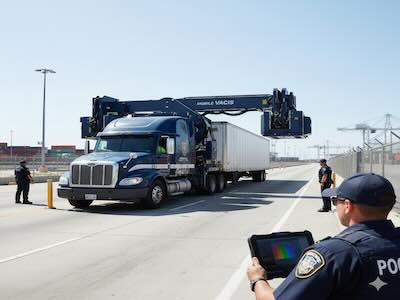
Drive-through cargo container inspection portal with high-energy X-ray
System Categories
1. Fixed Portal Systems
Permanent drive-through installations for high-volume screening:
Technical Specifications
| Parameter | Specification |
|---|---|
| Energy Range | 3-9 MeV (LINAC) or 1.2 MeV (Co-60 isotope) |
| Penetration | 300-400mm steel equivalent |
| Scan Time | 8-15 seconds per 40ft container |
| Throughput | 40-80 containers per hour |
| Resolution | 2-5mm wire detection capability |
| Maximum Vehicle Size | 4.5m (H) x 4.5m (W) typical |
| Power Requirement | 50-150 kW (LINAC systems) |
Design Configurations
- Single-View Portal: Horizontal beam scanning from one side
- Dual-View Portal: Horizontal + vertical beams for complete coverage
- Gantry Design: Overhead beam source with ground-level detectors
- Drive-Through Speed: 5-8 km/h during scanning
2. Mobile VACIS Systems
Vehicle and Cargo Inspection Systems for flexible deployment:
VACIS Technology Variants
- Mobile VACIS: Truck-mounted gamma-ray system (Co-60 or Cs-137 source)
- Z-Portal VACIS: Backscatter imaging for vehicle occupant detection
- Rail VACIS: Fixed systems for freight rail inspection
- VACIS II: Enhanced resolution with dual-energy capability
Operational Characteristics
| Feature | Mobile VACIS | Fixed Portal |
|---|---|---|
| Deployment Time | 20-30 minutes | Permanent installation |
| Scan Time | 2-5 minutes per vehicle | 8-15 seconds |
| Throughput | 12-20 vehicles/hour | 40-80 vehicles/hour |
| Cost | $1.5M - $2.5M | $3M - $6M |
| Flexibility | Multi-site deployment | Single location |
3. Air Cargo Screening Systems
TSA-certified equipment for air freight inspection:
Pallet/ULD Scanners
- Energy: 160-300 keV (lower than container systems)
- Tunnel Size: 2.5m x 3.0m typical (accommodates LD-3/LD-7 containers)
- Penetration: 75-150mm steel
- Throughput: 30-60 pallets per hour
- TSA ACSTL Certified: Air Cargo Screening Technology List approved
LINAC vs. Isotope Source Technology
Both technologies require substantial facility shielding because the megavoltage beam dose rate at the wall, unshielded, is many orders of magnitude above any occupied-area limit. See X-ray facility shielding and layout for the materials, calculations, and survey requirements that apply to high-energy installations.
Linear Accelerator (LINAC) Systems
Electrically-powered particle accelerators generating high-energy X-rays:
Advantages
- On/Off Control: Instant shutdown with no residual radiation
- Adjustable Energy: Selectable 3, 6, or 9 MeV for different cargo densities
- Deep Penetration: 400mm steel at 9 MeV
- No Radioactive Source: Eliminates dirty bomb theft concerns and NRC licensing
- Dual-Energy Capability: Material discrimination through spectral analysis
Disadvantages
- High Power Consumption: 100-150 kW during operation
- Complex Maintenance: Specialized technicians required for accelerator service
- Higher Capital Cost: $4M-$6M vs $2M-$3M for isotope systems
- Warm-Up Time: 15-30 minute initialization period
Cobalt-60 Isotope Systems
Radioactive source-based gamma-ray imaging:
Advantages
- Simplicity: No electrical power required for radiation generation
- Immediate Readiness: No warm-up time
- Lower Capital Cost: $2M-$3.5M
- Proven Technology: Decades of operational history
Disadvantages
- Fixed Energy: 1.17/1.33 MeV (cannot adjust)
- Limited Penetration: 200-250mm steel maximum
- Source Replacement: $300K-$500K every 5-10 years
- Security Concerns: Radioactive material requires NRC special nuclear material license
- Always Emitting: Mechanical shutter control (failure risk)
- Source Decay: Exponential decrease in intensity (5.3 year half-life)
Leading Manufacturers
Smiths Detection
HCV (High Cargo Volume) Series
- HCV Mobile: Truck-mounted LINAC for temporary deployments
- HCV Portal: Fixed gantry installation with dual-view imaging
- Energy: 3.5/6 MeV dual-energy for material discrimination
- Throughput: 60+ containers per hour
Rapiscan Systems
Eagle Series
- Eagle M60: Mobile VACIS with Co-60 source
- Eagle Portal: Drive-through LINAC system (4-9 MeV)
- Eagle Rail: Freight train inspection system
- Features: Z-Backscatter option for occupant detection
Nuctech (China)
XT Series
- XT100: Large-scale container inspection (3-9 MeV)
- Significant Market Share: Deployed at 100+ ports globally
- Cost Advantage: 20-30% lower than Western competitors
- U.S. Restrictions: CBP procurement prohibitions due to cybersecurity concerns
Leidos (formerly SAIC)
VACIS and EAGLE Systems
- VACIS XPL: Gamma-ray mobile inspection system
- EAGLE: Advanced mobile LINAC platform
- CBP Standard: Primary supplier for U.S. border operations
Deployment and Operations
Infrastructure Requirements
Fixed Portal Installation
- Footprint: 30-50 meters length for approach, scan zone, and exit
- Foundation: Reinforced concrete pad (30-50cm thick) for equipment
- Shielding: Concrete barriers (1-2m thick) or 15-30m exclusion zones
- Power Infrastructure: Three-phase 480VAC, 200-300A service
- Control Room: Climate-controlled operator station with workstations
- Network: Fiber optic or gigabit Ethernet for image transfer
Radiation Safety Zone
| Energy Level | Exclusion Radius | Shielding Alternative |
|---|---|---|
| Co-60 (1.2 MeV) | 15 meters | 1.0m concrete barriers |
| 3 MeV LINAC | 20 meters | 1.5m concrete barriers |
| 6 MeV LINAC | 25 meters | 1.8m concrete barriers |
| 9 MeV LINAC | 30 meters | 2.0m concrete barriers |
Operator Requirements
- Radiation Safety Training: 8-16 hours for high-energy systems
- Image Interpretation: 40-80 hours specialized cargo screening training
- Dosimetry Monitoring: Personal radiation badges required
- Annual Recertification: Competency testing and refresher training
Regulatory Compliance
United States
- NRC License: Required for radioactive sources (Co-60, Cs-137)
- State Registration: Radiation machine registration for LINAC systems
- OSHA 1910.1096: Occupational ionizing radiation exposure limits
- DOT 49 CFR 173: Transportation of radioactive materials
- CBP Approval: Equipment certification for U.S. port operations
International
- IAEA Safety Standards: International Atomic Energy Agency radiation safety
- WCO Framework: World Customs Organization equipment guidelines
- ISO 15390: Non-intrusive inspection system performance standards
Operational Performance
Contraband Detection Capabilities
High-Probability Detections
- Weapons: Firearms, ammunition, edged weapons (near 100% detection)
- Dense Contraband: Currency bundles, precious metals, electronics
- Concealed Compartments: False walls, hidden cavities in vehicles/containers
- Human Trafficking: Concealed persons in cargo areas
Moderate Detection Difficulty
- Narcotics: Organic materials require experienced operator interpretation
- Agricultural Products: Distinction from legitimate cargo challenging
- Explosives: Difficult without advanced dual-energy or CT
Throughput Benchmarks
| Facility Type | Daily Volume | System Type |
|---|---|---|
| Major Seaport | 500-1000 containers/day | Fixed portal (multiple lanes) |
| Land Border Crossing | 200-400 trucks/day | Fixed portal or mobile VACIS |
| Air Cargo Facility | 150-300 pallets/day | Pallet/ULD scanner |
| Special Event Security | 50-100 vehicles/day | Mobile VACIS |
Future Developments
Technology Enhancements
- Automated Threat Recognition: AI algorithms for contraband identification
- Multi-Energy Spectral Imaging: Beyond dual-energy for improved material discrimination
- 3D Reconstruction: CT-style volumetric imaging for cargo
- Faster Scanning: Sub-5-second inspection times with flash X-ray
Operational Improvements
- Remote Screening: Centralized image analysis from multiple ports
- Blockchain Integration: Immutable cargo tracking and screening records
- Smart Containers: RFID and IoT sensors for automated risk assessment
- 100% Scanning Mandate: U.S. SAFE Port Act implementation (phased rollout)
Last reviewed on 2026-04-27.